
- Region and Language
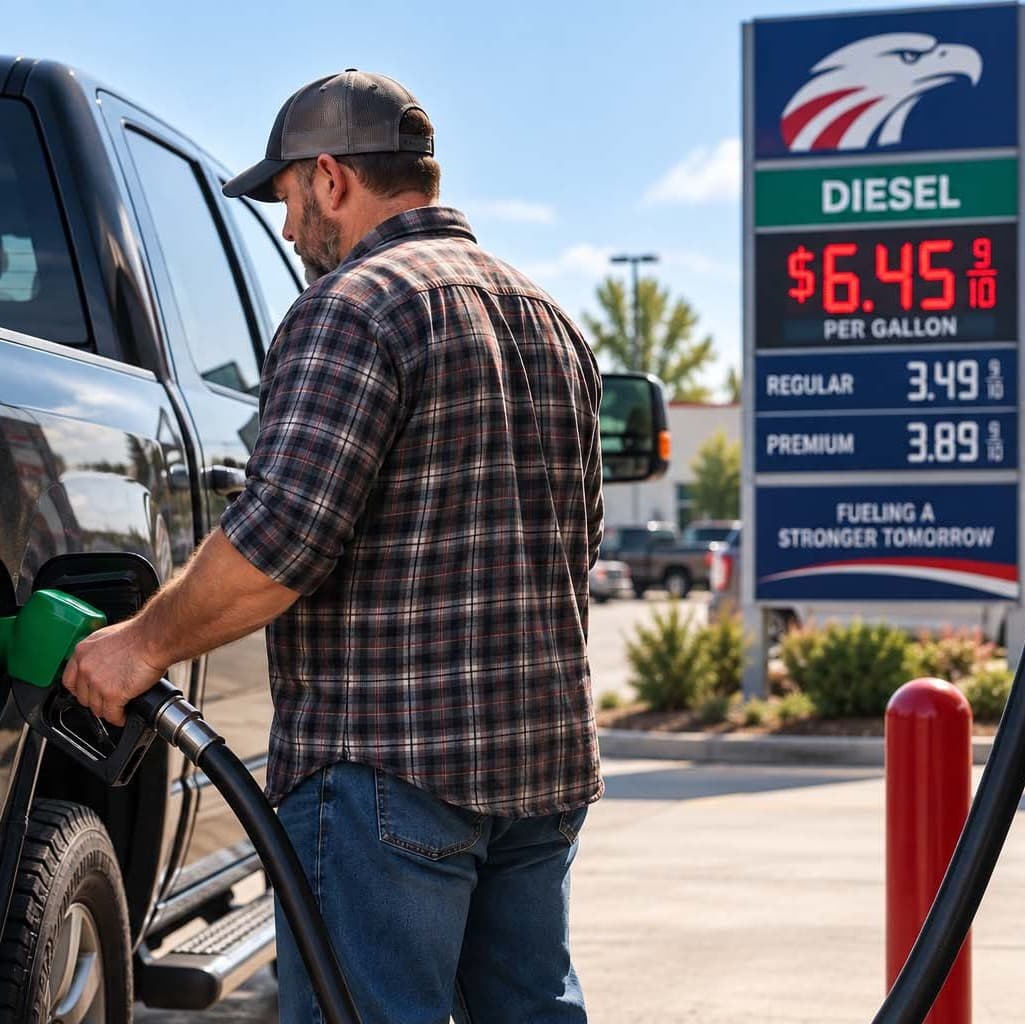
With U.S. diesel prices reaching $6 a gallon, fleets are facing higher fuel costs all around and greater pressure on operating budgets. While you can’t control diesel prices, you can reduce your exposure by focusing on costs they can influence, including unnecessary mileage, idling, driver behaviour, fuel purchasing, maintenance, and vehicle acquisition strategy. Connected fleet data, fuel controls, route optimization and telematics can help identify where avoidable costs are occurring, and which actions offer the greatest potential return. Longer term, fleets can also evaluate electrification where vehicle duty cycles, charging requirements and total cost of ownership support the transition.
Focus on the costs you can control. Rising diesel and gas prices make unnecessary mileage, inefficient driving and gaps in fuel purchasing controls more expensive, creating an opportunity to reassess where fuel dollars are going.
Use connected data to find the biggest opportunities. Bringing fuel, vehicle, telematics and operating data together can help fleets identify where costs are occurring and prioritize practical changes.
Reduce your fuel use. More efficient routing, reduced idling, and better driver behaviour can lower fuel consumption, while potentially reducing other mileage-related operating costs.
Use today’s diesel prices to inform longer-term fleet strategy. Replacement and electrification can reduce future fuel exposure where operating requirements, charging infrastructure, and total ownership costs support the change.
Focus on the costs you can control. Rising diesel and gas prices make unnecessary mileage, inefficient driving and gaps in fuel purchasing controls more expensive, creating an opportunity to reassess where fuel dollars are going.
Use connected data to find the biggest opportunities. Bringing fuel, vehicle, telematics and operating data together can help fleets identify where costs are occurring and prioritize practical changes.
Reduce your fuel use. More efficient routing, reduced idling, and better driver behaviour can lower fuel consumption, while potentially reducing other mileage-related operating costs.
Use today’s diesel prices to inform longer-term fleet strategy. Replacement and electrification can reduce future fuel exposure where operating requirements, charging infrastructure, and total ownership costs support the change.
When diesel prices hit $6 a gallon earlier this month, it undoubtedly caught the attention of those in the transportation industry. If you manage a fleet that relies on diesel vehicles, chances are it’s getting the attention of your finance team, too.
The reasons behind the increase are complicated. Higher crude prices, tight global diesel supplies, and geopolitical disruptions are all contributing to the pressure we’re seeing today. While prices may come down from current levels, I wouldn’t count on that happening in a significant way any time soon.
You can’t control the price at the pump, but you can control how that price affects your fleet.
Consider a medium-duty truck travelling 17,000 miles a year and averaging 9 miles per gallon. Moving from $4 to $6 diesel adds approximately $3,778 to its annual fuel bill. Across hundreds or thousands of vehicles, that number grows very quickly.
So where do you start? Here are five ways you can help soften the blow from rising diesel prices.
When fuel prices jump, there’s a natural temptation to start looking for savings immediately. I’d start one step earlier by getting a better understanding of exactly what is driving your fuel spend.
Look across fuel purchases, mileage, utilization, routes, maintenance, and driver behaviour. Which vehicles are consuming more fuel than expected? Where is mileage increasing? How much time are vehicles spending idling? Are there meaningful differences between locations, routes, or operating groups?
The challenge I’ve seen is that fleets often have much of this information already, but it lives in different places. Fuel may be managed through one system, telematics through another and routing somewhere else.
Bringing that information together can make it much easier to see where the real opportunities are. , for example, brings vehicle, telematics and operating data together to provide a clearer view of fleet performance and costs.
At $6 a gallon, preventable fuel spending gets expensive quickly.
It’s a good time to revisit how fuel is being purchased and whether your existing controls are strong enough. Depending on how your fleet refuels, that could mean looking for unauthorized purchases, transactions outside policy, or other forms of fuel misuse.
Many well-managed fleets already have strong controls in place. The question is whether there are additional gaps worth addressing or whether the process could be easier.
Solutions such as can use vehicle data to verify purchases and strengthen fuel controls, helping reduce avoidable spending.
This is one of the areas I’d look at very closely, particularly for service and delivery fleets.
Every mile you eliminate results in fuel savings. And the benefit doesn’t end there. Fewer miles can also mean less maintenance, tire wear and depreciation, so route optimization can affect considerably more than the fuel budget.
We’ve seen opportunities to reduce mileage by looking at how work is assigned, and vehicles are routed. You should question whether the routes that made sense yesterday still make sense today.
That’s where can be particularly valuable. Instead of simply trying to make each gallon cheaper, you’re reducing the number of gallons you need to buy in the first place.
At these fuel prices, unnecessary miles are worth another look.
The route determines where a vehicle goes. How it’s driven helps determine how much fuel it takes to get there.
Idling, speeding, and rapid acceleration can all increase fuel consumption. can give you visibility into those behaviours and help identify where targeted driver coaching could make a difference.
Again, this is about finding the specific opportunities in your fleet, rather than assuming every driver needs to change.
Small inefficiencies that may have seemed relatively insignificant before become harder to ignore at $6 a gallon. If the data shows a recurring pattern across dozens or hundreds of vehicles, even modest improvements can add up.
Fuel efficiency is also connected to decisions that may not immediately look like fuel decisions.
is a good example. Staying on top of routine service and basics such as tire pressure helps vehicles operate efficiently. Combining accurate mileage information with your maintenance program can also help make sure preventive maintenance happens when it should.
Then there’s the longer-term question: should every diesel vehicle in your fleet still be diesel?
I don’t think the answer is to start replacing diesel trucks with gas or electric simply because fuel is so expensive. Diesel remains the right choice for many applications involving heavy towing, payload, long distances, remote operations, and other demanding duty cycles.
But there are applications worth challenging.
We’re seeing some particularly interesting opportunities for electric with vehicles that:
travel predictable routes
return to base
accumulate significant annual mileage
have limited towing requirements
Medium-duty vehicles can be especially interesting because return-to-base operations can make depot charging more practical. They have incredible tourque as well, this is the case for diesel over gas and electric is better than diesel.
Electrification takes planning. Vehicle availability, acquisition cost, charging infrastructure and upfitting all have to be considered. But if you haven’t looked at your fleet through that lens recently, today’s diesel prices give you a pretty good reason to do it.
The chart below shows an example of the savings opportunities that exist with Element. These figures are based on a scenario where each vehicle travels 17,000 miles annually at 9 miles per gallon, consuming approximately 1,889 gallons of diesel. Savings equivalents below use a diesel price of $6 per gallon.
Savings opportunity | Basis for estimate | Equivalent savings at $6 per gallon |
Fuel station selection | Up to 8 cents per gallon | Up to 8 cents per gallon |
Fraud and misuse prevention | Up to 5% of fuel spend | Up to 30 cents per gallon |
Route optimization | Up to 3% reduction | Up to 18 cents per gallon |
Reduced idling | Up to 1.5% reduction | Up to 9 cents per gallon |
Improved preventative maintenance compliance | Up to 0.5% reduction (of maintenance spend) |
|
Total savings |
| Up to 65 cents per gallon1 |
Diesel won’t stay at exactly $6 forever. It could go down. It could go higher. That uncertainty is precisely why I think the bigger opportunity is to focus on the parts of the equation you can influence.
At Element, our fuel cost recovery approach starts by looking at your fuel, vehicle and operating data to identify where costs could potentially be reduced. From there, we can prioritize the two or three actions that make the most economic and operational sense for your fleet. That may involve fuel controls, connected vehicle data, route optimization, driver behaviour, maintenance, or longer-term vehicle strategy.
The economics can become meaningful at scale. In one illustrative model, a 1,000-vehicle medium-duty diesel fleet travelling 17,000 miles per vehicle annually at 9 mpg would absorb approximately $3.78 million in additional annual fuel costs when diesel rises from $4 to $6. The same model identifies up to $485,000 in potential annual savings, depending on the fleet, how it operates, and the controls already in place.
You may already be doing some of these things well, or you may find one opportunity rather than five.
The important thing is to have all the facts.
Talk to about how your fleet can reduce the impact of higher diesel prices today.
1 Illustrative only. Individual results may vary and depend on industry and fleet set up. Effective fuel cost is not a pump-price guarantee; it represents the modeled economic impact of multiple Element solutions.