
- Region and Language
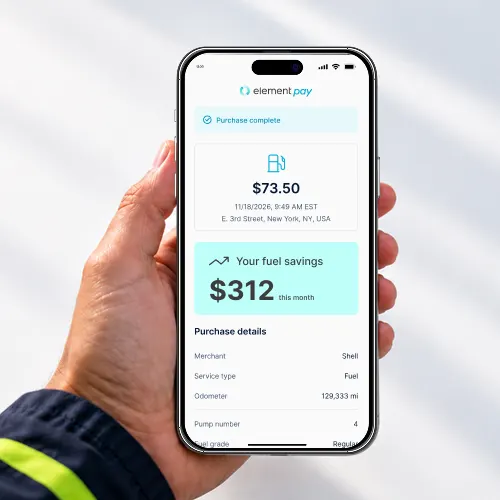
Every fuel purchase is an opportunity to control costs, but traditional payment methods often leave fleet managers responding to problems after the money has been spent. From unauthorized purchases and higher-priced fuel to lost cards and manual reconciliation, these challenges can put unnecessary pressure on fleet budgets. Element Pay has transformed how fleets pay for fuel by connecting payments directly to vehicles, giving fleet managers greater control over spending before purchases happen. The result is a smarter, simpler way to manage fleet fuel spending, with stronger controls and greater visibility into every transaction.
Connected payment controls can help prevent fuel fraud. By linking fuel purchases to vehicles and applying spending rules, fleets can identify suspicious activity and block transactions that fail authorization requirements. Telematics can provide additional vehicle information but isn't required.
Smarter fueling decisions can help maximize fuel savings. Guiding drivers toward lower-priced stations, setting spending limits, and monitoring purchases in real time can help fleets avoid unnecessary spending.
Eliminating physical fuel cards can simplify fleet operations. Digital payments and automatic receipt reconciliation reduce time spent managing cards, resolving PIN issues, and tracking fuel expenses, while making fueling more convenient for drivers. It also allows drivers to be onboarded in seconds.
Fleet fuel management is shifting from reactive to proactive. Connected payment and vehicle data give fleet managers greater visibility into fuel activity, helping them make more informed decisions instead of relying on after-the-fact reviews.
Imagine a security system that only tells you someone broke in after they've left. You know what happened, but the damage is already done.
Traditional fleet fuel controls work in much the same way. Spending limits and transaction alerts help identify questionable purchases, but often only after the fuel has been purchased.
And unauthorized spending isn't the only challenge. Drivers may pay more than necessary for fuel, while fleet teams spend valuable time replacing lost cards, resolving PIN issues, and reconciling receipts.
Today, digital fleet payments offer a more proactive approach. By connecting payments to vehicles and giving fleets greater control over where, when, and how fuel is purchased, solutions like Element Pay can help maximize fuel savings, prevent fraud, and eliminate the hassle of physical fuel cards.
“Moving from a physical fuel card to a digital payment is a step forward, but the real opportunity comes from connecting the payment to the vehicle. With vehicle-authorized payments, fleets can apply controls that help validate a purchase before fueling begins, giving managers greater confidence in how their fuel budgets are being spent,” said Anisha Hullihen, Vice President, Payment Operations, at Element.
Element Pay is a cardless fuel payment solution built around vehicle-authorized payments. Rather than relying solely on a payment card or digital wallet, it connects fuel purchases to vehicles and applies authorization controls to help validate transactions before fueling begins.
Drivers can use direct pay to authorize fueling through the Element Pay app, connecting the vehicle directly to the fuel station. Where direct pay isn't available, tap to pay allows drivers to use a digital card in their mobile wallet at supported stations.
Both payment methods provide real-time transaction data and spending controls, with the Element Pay fuel network currently extending to approximately 85,000 locations.
There’s an important distinction between identifying a questionable transaction and preventing unnecessary or unauthorized spending.
Detection asks: What happened?
Prevention asks: Does this transaction make sense before it proceeds?
A reactive approach can identify unusual activity after approval, leaving fleet teams to investigate the transaction and determine what happened. A more preventive approach introduces additional information and controls closer to the point of purchase.
Vehicle-authorized payments take fuel controls a step further by connecting purchases to the vehicle being fueled. Rather than evaluating transactions based on spending limits alone, Element Pay can apply payment rules and available vehicle information to help determine whether a purchase should proceed.
Element Pay considers several pieces of information together, including who is making the purchase, which vehicle is being fueled, where the transaction is taking place, the merchant, the amount and the timing.
When options like is available, the picture can become richer still. Vehicle location, driver-to-vehicle association, vehicle usage and available fuel or tank information can contribute to validation before fueling. Afterward, the completed transaction can be compared with vehicle data and expected fueling behaviour.
That changes the question from:
“Is this driver allowed to spend $100 on fuel?”
to something closer to:
“Does a $100 fuel purchase make sense for this driver, this vehicle, at this location, right now?”
“A fuel purchase can fall within a driver's spending limit and still raise questions,” Anisha said. “When you connect that transaction to the vehicle, you have more information to help determine whether the purchase makes sense. That gives fleet managers an opportunity to identify potential issues earlier, rather than relying solely on reviewing transactions after the fact.”
It’s important to keep in mind that fleets don’t necessarily need telematics to begin applying stronger controls. Transaction-level information such as driver authentication, merchant proximity, merchant eligibility, transaction frequency and configured payment rules can also help validate activity and identify exceptions. Telematics adds another layer of vehicle intelligence, but fleets don’t need it to use stronger payment controls.
Preventing unauthorized purchases is one way to protect your fleet's fuel budget. But what about the money spent on legitimate fuel purchases?
Fuel prices can vary between nearby stations, and drivers may choose a more expensive option simply because it's convenient or they're unaware of lower-priced alternatives. Across an entire fleet, those small price differences can add up.
That's where smarter fuel payment technology can make a difference. Element Pay helps drivers find lower-priced fueling locations, so they can make more cost-effective decisions at the pump. Fleet managers can also set spending limits and purchase rules to help keep fuel expenses within budget.
Real-time transaction data provides another opportunity to manage costs. Instead of waiting until the end of the month to review spending, fleet teams can monitor fuel purchases as they happen, identify unusual spending patterns, and find opportunities to improve fueling habits.
By helping drivers make better fueling decisions and giving managers greater visibility into spending, digital fleet payments can help reduce unnecessary fuel costs before they add up.
Fuel costs are only part of the equation. There's also the time and effort spent managing the payment process itself.
Lost cards need replacing. PIN problems need resolving. Receipts need reconciling. Drivers need help when something goes wrong at the pump.
Across a large fleet, those small administrative tasks can add up, taking valuable time away from more important work.
Cardless fuel payments offer a simpler approach. With Element Pay, fleet managers can onboard new drivers in seconds, without waiting for physical fuel cards to arrive. Drivers can access digital payments through the Element Pay app, reducing the administrative work associated with managing fuel expenses.
For fleet managers, eliminating physical cards means fewer replacements, PIN resets, and payment-related support calls. Digital receipts and automatic reconciliation also reduce the manual work of matching transactions to vehicles and tracking fuel expenses.
The result is a more convenient fueling experience for drivers and less administrative work for the teams managing fleet payments.
For fleets using Element Pay, the benefits are already measurable. One property and community services company reduced its annual fuel spending by 13.6%, demonstrating how better visibility and payment controls can contribute to meaningful savings.
A security and investigations company saved 10 hours a week in back-office work by reducing time spent reviewing receipts, reconciling expenses, and investigating potential misuse. The company also identified 14.2% of fuel transactions as misuse, giving its team greater visibility into questionable spending.
Meanwhile, a field services company saw a 25% reduction in time spent helping crews resolve fuel payment issues, including lost cards and PIN problems. It also identified $150,000 in potential misuse spending over 45 days.
Together, these results show how smarter fuel payments can help fleets control spending, identify potential fraud, and reduce administrative work.
For fleet managers, taking greater control of fuel spending starts with understanding where costs, risks, and administrative challenges exist in the current payment process.
A few questions can help:
Can your payment solution help drivers find lower-priced fuel stations?
Are fuel purchases checked against spending rules before they're approved?
Can each fuel transaction be connected to the appropriate vehicle and driver?
How quickly can your team identify unusual or unauthorized fuel purchases?
How much time does your team spend replacing fuel cards, resolving PIN issues, and reconciling receipts?
Could a cardless payment experience make fueling easier for your drivers?
The answers can help identify opportunities to reduce unnecessary fuel spending, strengthen payment controls, and simplify day-to-day fleet operations.
Managing fleet fuel costs shouldn't mean choosing between stronger controls and a simpler payment experience. With the right digital payment solution, fleets can guide drivers toward lower-priced fuel, prevent unauthorized purchases, and reduce the administrative work associated with physical fuel cards.
Discover how Element Pay can help your fleet maximize fuel savings, prevent fuel fraud, and eliminate physical fuel cards. Talk to an Element fleet payment expert to explore your savings opportunities.