
- Region and Language
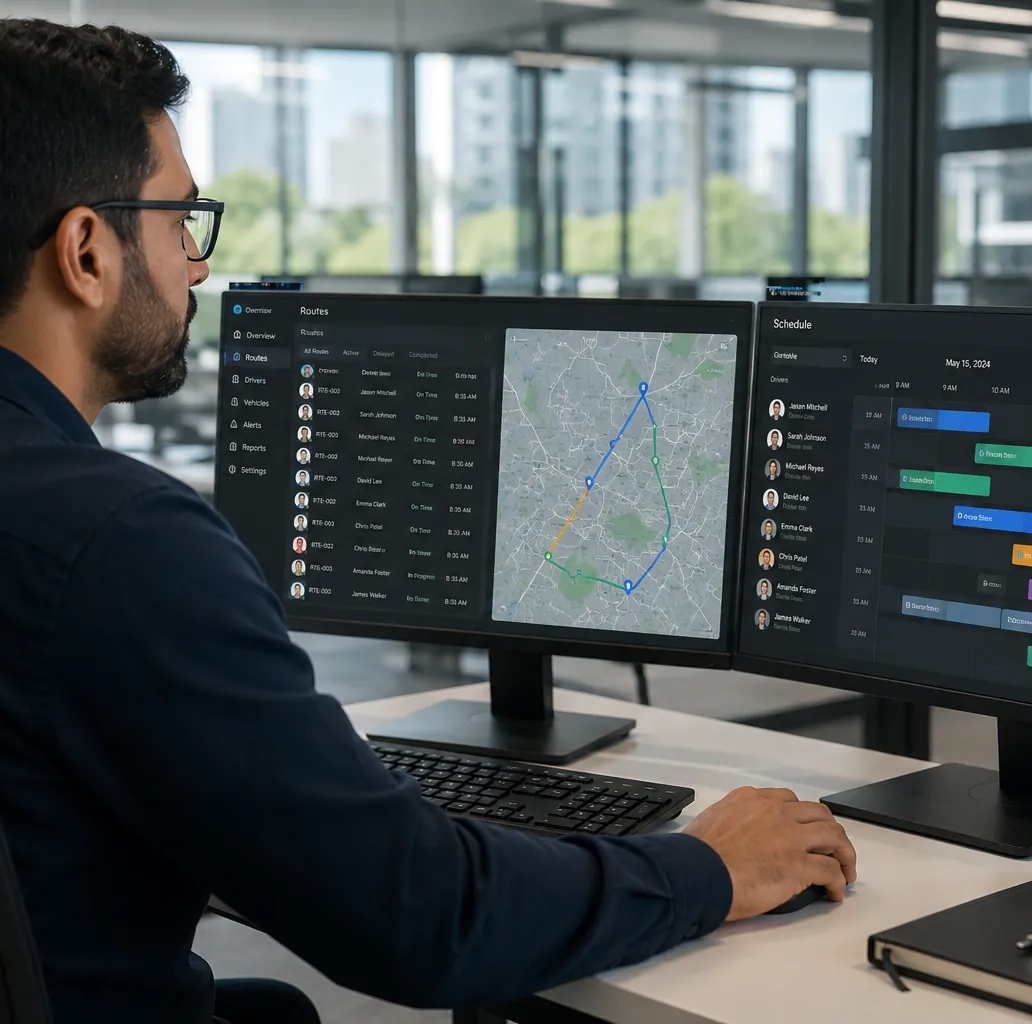
A unified transport platform enables operators to manage both on-demand and scheduled services within a single system. By unifying demand, routing, and fleet optimization, it eliminates inefficiencies caused by fragmented tools and manual coordination. This approach allows mobility and logistics operators to improve utilization, reduce costs, and scale operations without adding complexity.
Unified transport is becoming the default, but most systems aren’t built to handle both models together
Fragmented tools create inefficiencies, manual work, and limit scalability
A unified transport platform unifies routing, demand, and fleet management in real time
End-to-end platforms help operators scale efficiently while improving service and reducing costs
Unified transport is becoming the default, but most systems aren’t built to handle both models together
Fragmented tools create inefficiencies, manual work, and limit scalability
A unified transport platform unifies routing, demand, and fleet management in real time
End-to-end platforms help operators scale efficiently while improving service and reducing costs
Unified transport (scheduling for both fixed and on-demand routes) has quickly become commonplace. What used to be a clear divide between the two service types is starting to blur. Microtransit systems are filling gaps in traditional networks. Paratransit providers are introducing dynamic routing. Shuttle operators are combining reservations with real-time pickups.
This shift is happening because they don’t have a choice. Demand is less predictable than it used to be. Most service-level agreements (SLA) stipulate flexibility while cost pressure is forcing every operator to rethink how efficiently they’re using vehicles, drivers, and routes.
So, teams try to adapt. They layer on-demand capabilities onto scheduled systems. Or they add fixed routes to an on-demand model.
At first, it works but then things start to break.
Running a unified service sounds straightforward in theory. In practice, it creates tension across almost every part of the operation. At the core of the problem are two very different service models.
Scheduled services are built around predictability. Routes are fixed. Capacity is planned in advance. The goal is consistency.
On-demand services work in real time. Routing changes constantly and demand is unpredictable, so the goal is responsiveness.
Trying to run both at once creates friction.
The primary issue is that traditional planning is slow, and any change to the plan has cascading effects that take a long time to figure out. Vehicles that are locked into scheduled routes may sit underutilized while demand spikes elsewhere. Drivers are assigned based on static plans, even when conditions change. Dispatchers are forced to make trade-offs without a full view of the system.
Now layer in the tools most teams rely on. Scheduling lives in one system. Dispatch in another. in a third. Data is scattered, delayed, or incomplete.
So, when something changes, and it always does, the response is manual. Calls, overrides, and last-minute decisions.
That’s where hybrid operations start to struggle. Because the system at the foundation isn’t built for it.
Fragmentation doesn’t always look like a problem at first. In fact, many operations run this way for years. A scheduling tool here, a dispatch platform there. Each piece works, but it’s the gaps between them where things get expensive.
As long as the operation is small, this can work, When systems don’t communicate, teams become the glue. They move information from one place to another. They reconcile conflicts and make judgment calls with partial data. But over time this is unsustainable.
As the operation grows, that burden grows with it. More vehicles mean more edge cases. More services mean more coordination. More demand means more pressure to respond quickly.
Instead of scaling smoothly, the operation becomes heavier. You see it in small ways at first. Idle vehicles in one part of the network while another area is stretched thin. Routes that could be combined but aren’t. Decisions that arrive a few minutes too late to matter.
Over time, those inefficiencies compound, and the biggest limitation shows up when you try to optimize across the entire system.
You can’t.
Each tool is optimizing for its own slice of the operation, while no one is optimizing for the whole.
If unified operations are a systems problem, then solving them requires a system that can see and act on the whole picture. That starts with how demand is handled.
Scheduled trips and real-time requests need to flow together into the same system, not side by side. Every decision about routing, matching, and allocation depends on that shared view.
From there, routing has to evolve. Instead of optimizing fixed routes and on-demand trips separately, the system needs to evaluate them together in real time. Every new request should trigger a re-evaluation of how vehicles are being used across the network.
That only works if the platform can rebalance resources dynamically. And if the system is set up to reoptimize incrementally, allowing it to generate a new plan in a matter of seconds or minutes, not hours
Vehicles shouldn’t be locked into static assignments. They should shift based on demand, availability, and service priorities. The system needs to make those decisions instantly, without waiting for manual input.
Underneath all of this is a centralized control layer that offers one source of truth for data. One system coordinating the entire operation.
And ideally, that system anticipates rather than reacts. Predictive demand modeling allows operators to position vehicles before demand spikes. It turns operations from reactive to proactive.
For buyers evaluating solutions, this becomes a useful checklist. If a system can’t do these things natively, it will struggle to support hybrid operations at scale.
At a certain point, adding more tools stops being helpful. What operators need instead is cohesion.
An end-to-end platform brings scheduling, routing, dispatch, and optimization into a single system. That changes how decisions are made.
Instead of multiple tools competing for control, there is one optimization engine coordinating everything. Every vehicle, every trip, every constraint is considered together.
That unified approach unlocks something fragmented systems can’t deliver. Continuous improvement.
As more data flows through the platform, performance improves. Routing gets smarter. Allocation becomes more precise. The system learns from every decision.
Operationally, the impact is just as important.
Manual coordination drops. Teams spend less time reacting and more time managing exceptions that actually matter. Growth becomes easier to absorb because complexity is handled by the system, not by adding headcount.
This is why more operators are starting to think in terms of platforms rather than tools. The platform becomes the operating system for the entire mobility service.
The value of a unified approach becomes clearer when you look at how hybrid models show up in practice.
Microtransit. Cities are using on-demand services to extend the reach of fixed routes. High-density corridors stay fixed. Lower-demand areas are served dynamically. When both are coordinated in one system, coverage improves without increasing fleet size.
Airport shuttles. Operators often deal with a mix of reservations and walk-up passengers. Without coordination, this leads to either empty seats or long wait times. A unified platform can combine both demand types and adjust routes in real time to maximize utilization.
Paratransit. Providers still need to honor scheduled commitments, but dynamic routing can reduce travel times and improve service quality. The challenge is balancing reliability with flexibility. That balance is much easier to achieve when both are managed together.
Delivery services - This dual approach allows businesses to run on-demand and planned deliveries on the same platform, be it food and parcel delivery, or courier point-to-point delivery services together with last mile delivery.
In each case, the difference comes down to coordination. Without a platform, services operate in silos. With a platform, they function as one system.
Not every platform is built to handle hybrid operations. For operators evaluating options, a few capabilities matter more than others.
First, the system should support both scheduled and on-demand services natively. If one has been added as an afterthought, it will show up in performance and limitations.
Second, the optimization engine needs to be central. Routing, matching, and rebalancing should all be driven by the same logic.
Real-time adaptability is another key factor. Conditions change constantly in hybrid operations. The platform should respond immediately, not rely on batch updates or manual intervention.
Scalability is where many systems fall short. Growth should not introduce more operational overhead. If adding vehicles or services requires more coordination, the system isn’t doing enough of the work.
Finally, integration still matters. Most operators aren’t starting from scratch. The platform should connect with existing systems while gradually reducing reliance on fragmented tools.
Unified is the future, but only if you can operate it
Hybrid transport is already here. The real question is how well it’s being managed.
When hybrid operations are supported by fragmented systems, complexity shows up as inefficiency. Costs rise. Service quality suffers. Growth becomes harder than it should be.
When the same operations are supported by a unified platform, that complexity becomes manageable. Even valuable.
Operators gain flexibility without losing control. They improve utilization without sacrificing reliability. And they can scale without constantly reworking how the operation runs.
If you’re already feeling the strain of hybrid operations, you’re not alone.
The difference comes down to whether your system was built for it.
to see how hybrid fleet optimization works or book a demo to explore it in your own operation.